Research
Material Surface Texture Recognition Based on Triboelectic Sensor and Deep Learning
1
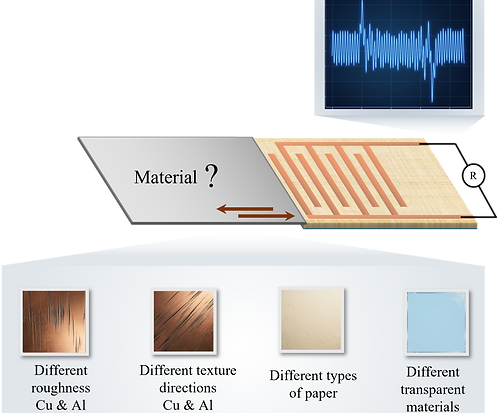
traditional surface morphology inspection mostly relies on precision equipment such as contact profilometers or optical interferometers, which are expensive and cumbersome to operate. For instance, contact probes can easily scratch soft or fragile materials, while optical instruments face limitations when inspecting transparent films or highly reflective metals. In recent years, triboelectric sensors (TES), with advantages such as self-powering capabilities, low manufacturing costs, and real-time sensing, have gradually emerged as a promising alternative for material recognition technology.
2
This study developed a classification system combining a sliding-mode triboelectric sensor and deep learning. The results show that the system achieved a classification accuracy for copper, aluminum, paper, and transparent conductive films with different surface textures, verifying its feasibility for subtle texture classification.